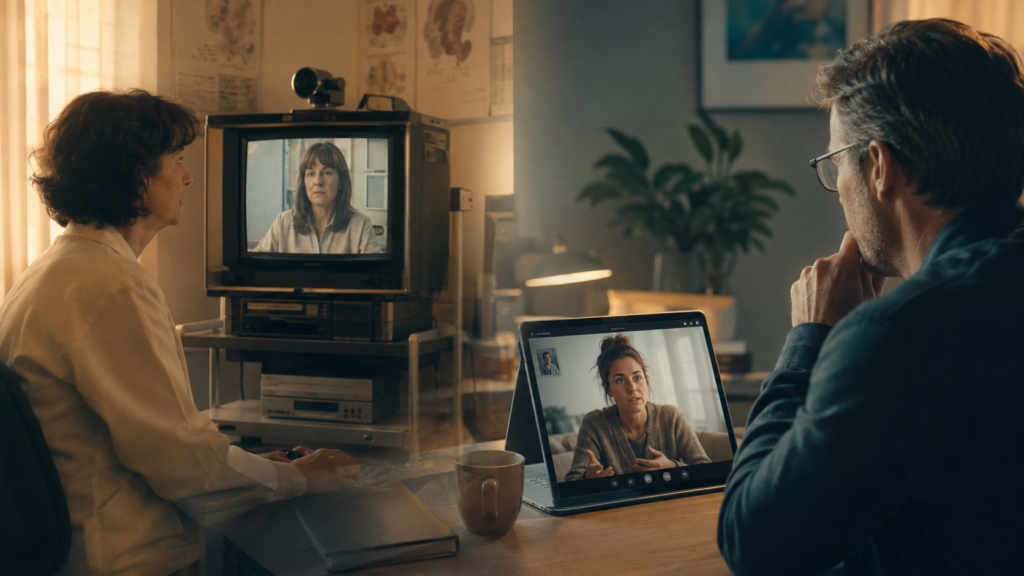
The first documented psychiatric video consultations date back to 1959. The technology of that time had very little in common with today’s secure video platforms, but the basic idea was the same: If the right treatment is not available where a person lives, technology can bring treatment closer.
This also became the starting point for my own work in Denmark in the early 2000s. Among other things, I worked with refugees and immigrants who often needed an interpreter. Interpreters can be both necessary and valuable, but psychiatric conversations are not only about translating words. Tone of voice, pauses, shame, humour, cultural references and traumatic experiences can be crucial. So a simple question arose: If the right psychiatrist is somewhere else and speaks the patient’s own language, why should geography stand in the way?
I remember an early video consultation in 2004 between Silkeborg and Copenhagen. The patient looked at the screen and asked: “Can the whole of Denmark see us now?” When it was explained to her that the connection was confidential, she spoke for the first time about a serious trauma she had previously been afraid to share through an interpreter. For me, this became a very concrete example of how physical distance does not necessarily have to create human distance.
In 2004–2005, I developed and implemented a transcultural telepsychiatry model in Denmark based on direct language and cultural matching. In 2006, the model was expanded through cooperation between Denmark and Sweden, enabling patients in Denmark to meet psychiatrists in Sweden in their own language without the routine use of interpreters. Later, telepsychiatry became part of many more areas: assessment, treatment, follow-up, second opinions, supervision and shared care.
During COVID-19, the world was forced to discover rapidly something that the field had been working on for decades. The need for common standards subsequently led to the WPA Telepsychiatry Global Guidelines, first published in 2021 and extensively updated in 2024. Today we talk a great deal about AI, apps and digital twins, but telepsychiatry remains relevant because the old problems persist: distance, shortages of specialists, waiting times and language barriers. Technology changes. The need remains.