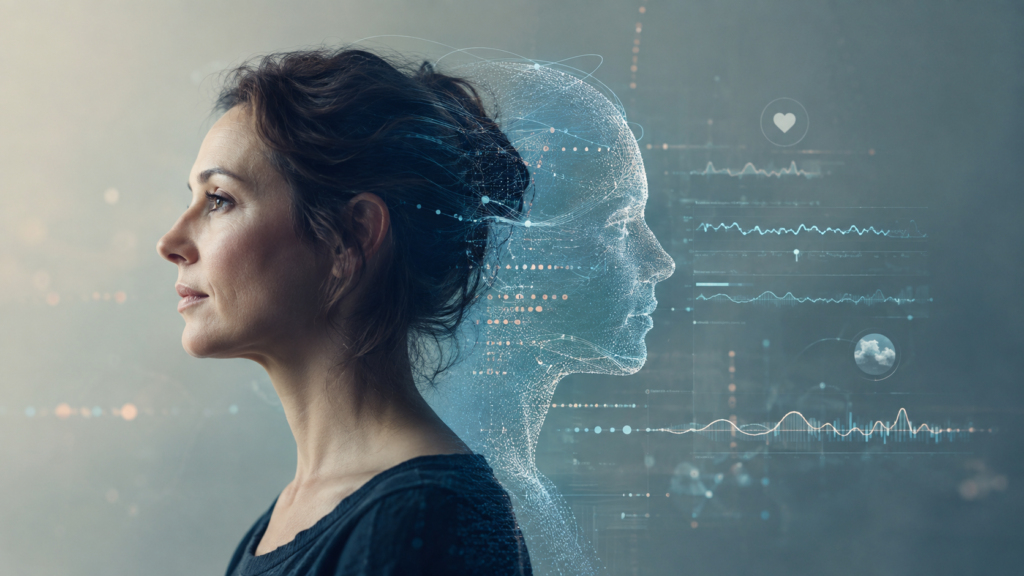
A digital twin sounds like science fiction, but the idea is already used in other areas of medicine and is now being investigated in psychiatry as well. A digital twin is not an avatar or a copy of someone’s personality. It is a digital model that is continually updated with selected information about a person—for example sleep, activity, symptoms, medication response and clinical assessments—to track how health develops over time.
What is interesting is the possibility of moving from a snapshot to a continuing picture. During a consultation we may ask: How have you slept? Have you been more or less active? How has your mood been since the last visit? A dynamic model could in principle follow such changes between consultations and notice that a pattern is shifting. If sleep, activity and social contact change simultaneously, for example, the system might suggest that it is time to look more closely at the situation—not that a diagnosis has been proven.
Here lie both the potential and the problem. Imagine a medical student studying from morning until night for a demanding exam over several weeks. The student moves less, replies to messages less often and perhaps calls family less frequently. An algorithm might interpret this as social withdrawal and reduced activity associated with depression. But the student may simply be busy preparing for the examination. A smartwatch or a digital model can detect that something has changed; it does not necessarily know why.
Digital signals must therefore always be interpreted in context. More data does not automatically mean more understanding. The more information a model uses—medical records, phone, wearable, biological data—the more significant the questions about consent, privacy, ownership and surveillance become. Digital twins in mental health remain experimental and are far from routine treatment.
The most interesting possibility is not to “copy” the person, but to detect a point when early help can still make a difference. The results should be taken with a pinch of salt. Technology can be very valuable, but human judgement is invaluable. A good principle is: Digital signal first. Human assessment afterwards.
Further reading
- Spitzer M, Dattner I, Zilcha-Mano S. Digital twins and the future of precision mental health. Front Psychiatry. 2023.
- Katsoulakis E, et al. Digital twins for health: a scoping review. npj Digital Medicine. 2024.
- Verhees FG, Wiest IC, Kather JN, et al. Blocking the Reflection: Milestones and Hurdles for Digital Twins in Mental Health. 2026.