
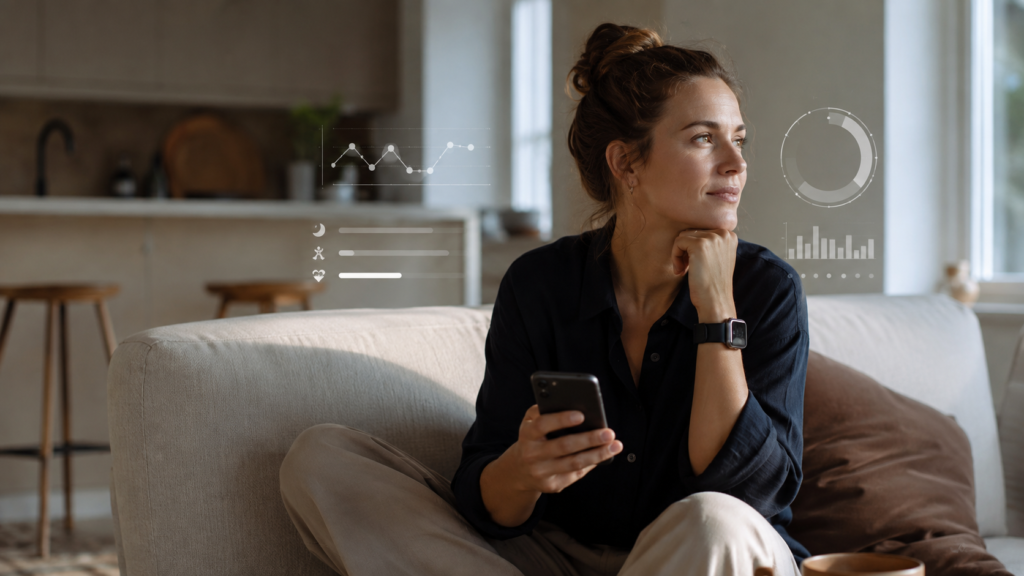
A smartwatch can record sleep, activity and pulse, while a smartphone can register patterns of movement and changes in how we use the phone. When such data are followed over time, they may complement the psychiatric conversation with information from the many hours when the person is not in the consulting room. This is often called digital phenotyping.
Bipolar disorder provides one example. A person normally sleeps around seven hours and has a reasonably stable level of activity. Over several days, sleep falls to four hours, activity increases and the person also experiences more energy. None of these observations alone proves mania, but the combination can be a signal that something is changing. If the signal is detected early, it may prompt a conversation before an actual crisis develops.
What often matters is the change from the person’s own baseline. For one person, 3,000 steps may be a perfectly ordinary day, while for another it may represent a marked drop from 12,000. Similarly, poor sleep may be due to an emerging illness, but also to a baby at home, night work, pain or a worrying life situation. The sensor sees the change; it does not necessarily know the cause.
More data is therefore not automatically better treatment. Before measuring anything, we should be able to answer a simple question: What will we do differently if this information changes? If no one acts on a signal, monitoring has limited clinical value. And if data are collected passively, the person must understand what is recorded, why it is recorded, who can see the information and what happens when an alert is triggered.
Wearables and phone data may in future become useful as early signs of change, treatment response or relapse. But a digital pattern is not a diagnosis. A watch can measure, a phone can record, and an algorithm can identify a pattern. That pattern must still be understood within a person’s life. Digital signal first. Human assessment afterwards.
Further reading
- Onnela J-P, Rauch SL. Harnessing Smartphone-Based Digital Phenotyping to Enhance Behavioral and Mental Health. Neuropsychopharmacology. 2016.
- Choi KW, Ooi J, Lottridge D, et al. Digital phenotyping in mental health: systematic review. 2024.
- Systematic review of digital phenotyping for depression. 2024.