
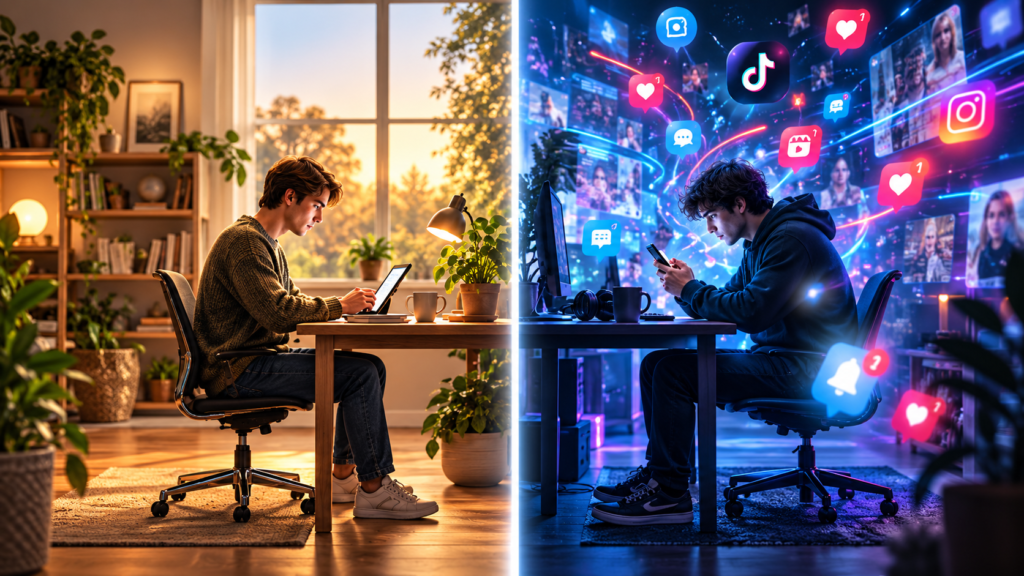
Why screen time does not tell the whole story
Is the mobile phone good or bad for our mental health? Do social media make us lonely? And how many hours of screen time are too many?
These are understandable questions, but there is no single answer that fits everyone. Research finds negative, small and neutral associations, while digital media can also provide support, community, learning and opportunities for self-expression [1].
Imagine two people who each spend an hour on their phone. One has a video call with his son and grandchildren abroad and feels less lonely afterwards. The other scrolls through conflicts, accounts of illness and pictures of people with seemingly perfect lives, and feels more anxious afterwards.
The time is the same. The effect is not.
That is why simply counting minutes is not enough. The DID model highlights three factors: Dose—how much, how often and in what way we use digital media; Content—what we see, read and participate in; and Disposition—who we are, including age, personality, life situation and mental state [1].
The Danish Health Authority also emphasises that research has not established a single time limit that works for everyone. Instead, screen use should be considered in relation to sleep, physical activity, social connections and wellbeing [2].
The DID model is not a definitive truth. It is based on a narrative mini-review rather than a systematic analysis of all research. Its main strength is that it helps us ask better questions [1].
References
Gupta L, Bharti D, Singhal S. Not all clicks are equal: digital dose, content, and user disposition in mental health. Academia Mental Health and Well-Being. 2026;3(1). doi:10.20935/MHealthWellB8208.
Sundhedsstyrelsen. Sundhedsstyrelsens anbefalinger om skærmbrug. København: Sundhedsstyrelsen; 2023, opdateret 2024.