
We need both a brake and a steering wheel
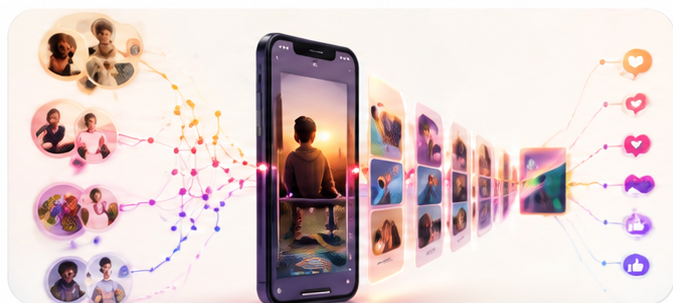
What appears on our screens is not random. Social media learn from what we pause at, click on, watch to the end or share. They then show us more of the same.
The algorithm’s aim is usually to hold our attention. It does not necessarily select what is most truthful, nuanced or beneficial to our mental health [1]. If someone watches several videos about illness, their feed can quickly fill with illness-related content. If a young person views a great deal of weight-loss content, increasingly extreme material about bodies and food may appear.
Digital literacy is therefore also part of mental health. The Danish Media Council for Children and Young People emphasises that young people should understand the mechanisms behind personalised recommendation algorithms [2]. Research also suggests that people who know their feed is selected and driven by engagement may adopt a more active, critical approach to its contents [3].
Screen-time limits can help, but they are only a brake. We also need a steering wheel to guide us in a better direction. That might mean switching off unnecessary notifications, unfollowing accounts that make us unhappy, choosing specific times for news and deliberately seeking content that offers knowledge, calm or community.
A useful principle is: Believe in many things—and question everything. We can believe in technology’s possibilities while also questioning what it shows us.
Ask yourself from time to time: Why am I seeing this? Who decided that it should be shown to me? How do I feel afterwards? What do I want to see more—and less—of?
Living entirely without digital media is not realistic. Nor is the aim to turn technology into an enemy. The aim is to use it more consciously, so that we remain in control of the direction.
References
Gupta L, Bharti D, Singhal S. Not all clicks are equal: digital dose, content, and user disposition in mental health. Academia Mental Health and Well-Being. 2026;3(1). doi:10.20935/MHealthWellB8208.
Medierådet for Børn og Unge. Unge og algoritmer. Undervisningsmateriale om personlige anbefalingsalgoritmer.
Hu A, Ou M. From passive to active: how does algorithm awareness affect users’ news seeking behavior on digital platforms. Telematics and Informatics. 2025;100:102291. doi:10.1016/j.tele.2025.102291.