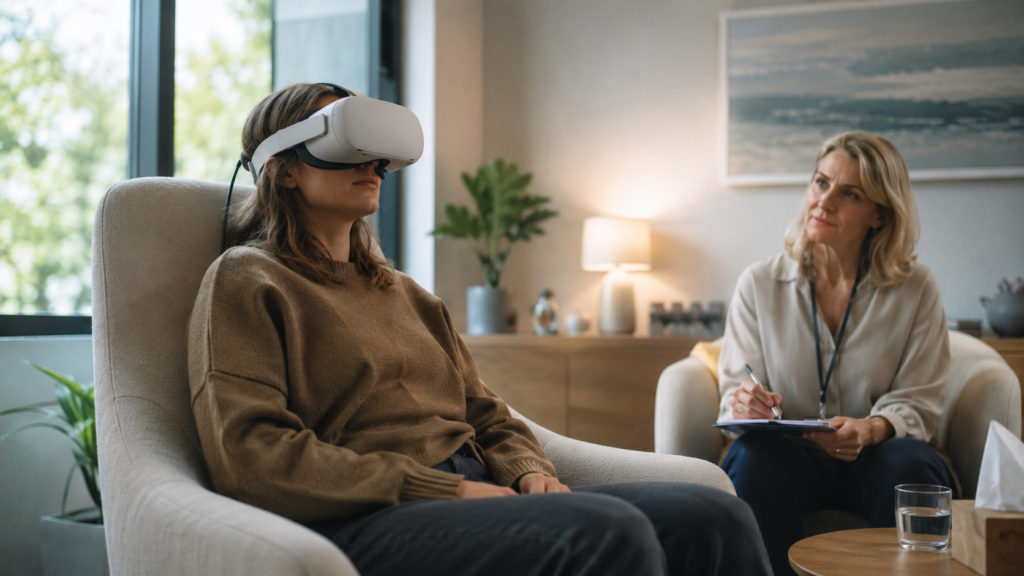
Virtual reality is still most commonly associated with gaming, but in psychiatry the technology can be used for something very concrete: creating situations a person needs to practise but that may be difficult to arrange in real life. When a VR environment feels sufficiently realistic, the body can respond with genuine distress, a change in pulse and anxiety, even though the person knows the situation is virtual.
Consider someone with a severe fear of flying. Conventional exposure may require trips to an airport and perhaps an actual flight. With VR, treatment can begin much more gradually: first standing in a virtual terminal, then boarding, sitting in the aircraft and finally experiencing take-off and turbulence. The same principle can be used for fear of heights, spider phobia or social anxiety, where someone may, for example, practise speaking in front of a virtual audience. The situation can be repeated and its difficulty adjusted along the way.
The point is not to escape reality but to practise for it under controlled conditions. The virtual environment is a training room. What is learned there should gradually be usable without a headset in real life. That is precisely why VR is most interesting when technology makes an existing, well-documented treatment method more practical, accessible or precise.
VR is also being studied for PTSD, psychosis, rehabilitation and social skills training. But an impressive digital environment is not in itself a treatment. Some people experience nausea, dizziness, headaches or disorientation, and intense virtual experiences may in some circumstances increase anxiety or other symptoms. There must therefore be a clear clinical purpose, appropriate dosage and follow-up.
As with other digital tools, the question should be: What problem is technology helping us solve? If VR makes an otherwise difficult treatment possible or easier to complete, it can have great value. If it merely makes treatment more technological, that is not enough. The virtual must create value in the real world.