
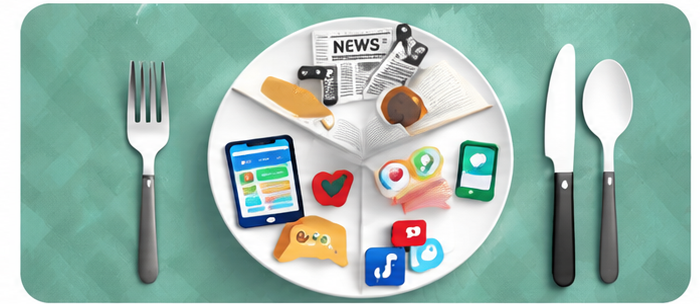
A phone can provide access to family, education, music, art, health information and community. It can also fill our day with unrealistic body ideals, conflict, hidden advertising, bullying and frightening news.
On social media, we often see carefully selected highlights from other people’s lives. We may compare our ordinary Tuesday with an influencer’s holiday, workout, home or appearance. Research indicates that exposure to people who appear more attractive or successful can negatively affect how we evaluate ourselves and how we feel [1]. This association is especially relevant for people already struggling with body insecurity or depressive symptoms [2].
Danish children and young people also report that social media bring both a sense of belonging and pressure. The Danish organisation Børns Vilkår describes how phones are central to daily life, but also how influencers, body ideals, disturbing videos and endless content take up considerable space [3], [4].
Another example is doomscrolling: reading one negative story after another about war, illness or disasters. We may seek an overview but end up feeling more anxious and helpless [5]. Cyberbullying and toxic online conversations are associated with depression, anxiety and self-harm, especially among young people [6].
Fortunately, digital content can also be constructive. An older person may find a community. A young person may learn to play guitar. A stressed employee may use a nature video or guided exercise to relax. Creative software, education and some games can offer immersion and a sense of mastery [5].
The key question is therefore not only whether we are online, but also what we allow in. Just as we choose our food, we can choose a healthier digital diet: more of what offers knowledge, connection and meaning—and less of what leaves us anxious, envious or exhausted.
References
McComb CA, Vanman EJ, Tobin SJ. A meta-analysis of the effects of social media exposure to upward comparison targets on self-evaluations and emotions. Media Psychology. 2023;26(5):612-635. doi:10.1080/15213269.2023.2180647.
Bonfanti RC, Melchiori F, Teti A, et al. The association between social comparison in social media, body image concerns and eating disorder symptoms: a systematic review and meta-analysis. Body Image. 2025;52:101841. doi:10.1016/j.bodyim.2024.101841.
Børns Vilkår. Ny rapport om børn og sociale medier: At være på mobilen er den foretrukne hverdagsaktivitet blandt børn i 7. klasse. 2024.
Børns Vilkår. Børn og unge jagter uopnåelige kropsidealer: “Udseende er vigtigere end personlighed”. 2026.
Gupta L, Bharti D, Singhal S. Not all clicks are equal: digital dose, content, and user disposition in mental health. Academia Mental Health and Well-Being. 2026;3(1). doi:10.20935/MHealthWellB8208.
Kowalski RM, Giumetti GW, Schroeder AN, Lattanner MR. Bullying in the digital age: a critical review and meta-analysis of cyberbullying research among youth. Psychological Bulletin. 2014;140(4):1073-1137. doi:10.1037/a0035618.